
Choosing Your Coding Agent: Summer 2026 Edition
By Daniel Ensminger
We compare the latest frontier models to help you navigate the trade-offs between orchestration, latency, and cost for your production agentic workflows.
Building production-ready software engineering agents is no longer about finding a model that can write a clean helper function. As of July 2026, the frontier has shifted toward long-horizon agentic workflows, multi-step reasoning, and complex repository refactoring.
If you are architecting an agentic workflow today, your choices dictate your system’s latency, execution accuracy, and operating margins. Let's break down the summer 2026 state of the art, evaluating SpaceXAI’s Grok 4.5, Anthropic’s Claude Fable 5 and Claude Opus 4.8, and OpenAI’s GPT-5.6 Sol.
State of the Frontier: Model Capabilities Overview
The current crop of frontier models diverges sharply in their architectural design and intended use cases. Selecting the wrong model for your specific agentic pattern will lead to stalled execution loops or runaway API bills.
Claude Fable 5
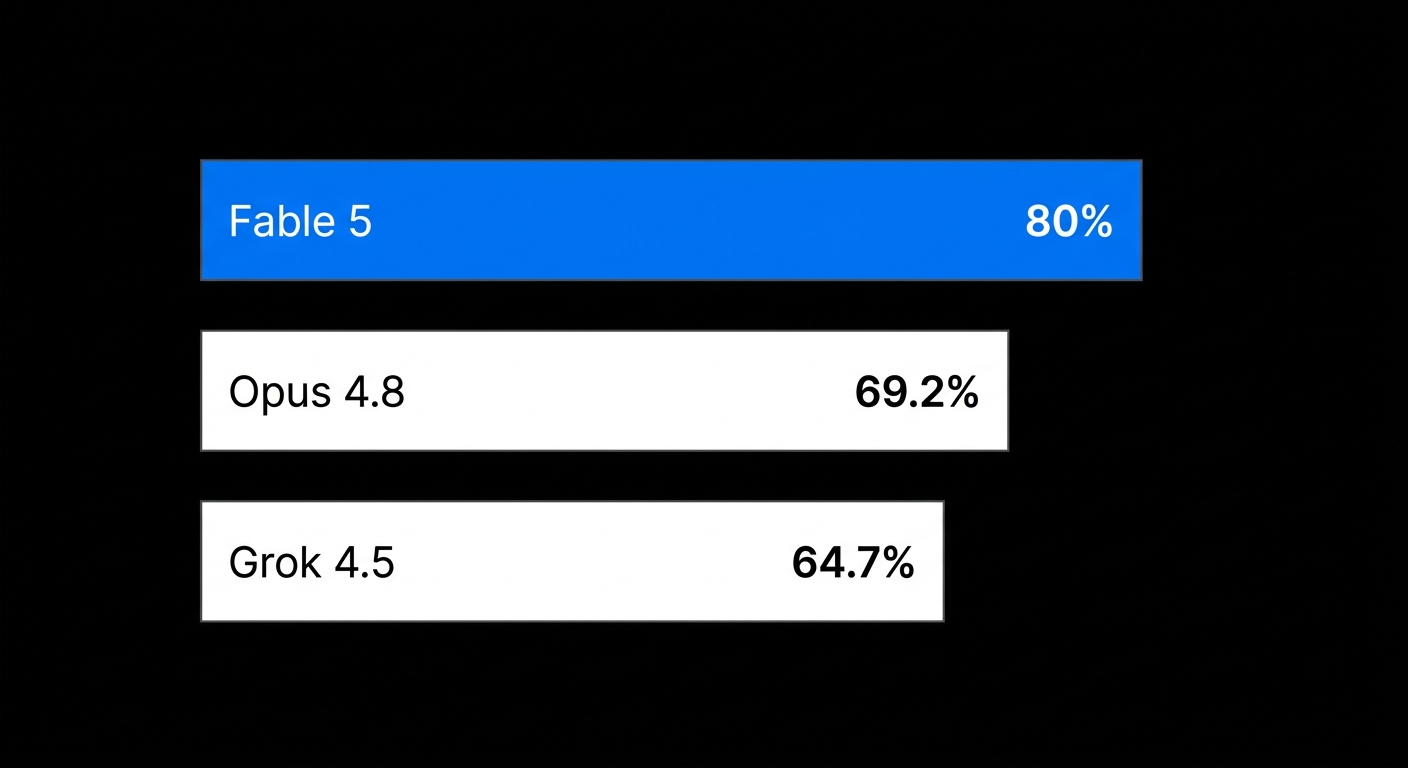
Released on June 9, 2026, Claude Fable 5 is Anthropic's flagship "Mythos-class" model designed specifically for long-horizon agentic workflows. It introduces Dynamic Workflows, an architectural feature allowing the primary agent to programmatically spin up and manage hundreds of parallel subagents. This massive hierarchical orchestration allows Fable 5 to lead the industry in complex, repository-wide reasoning, claiming the top spot on SWE-bench Pro at 80.0%. However, its performance is highly deliberate and gated by aggressive cybersecurity guardrails.
GPT-5.6 Sol
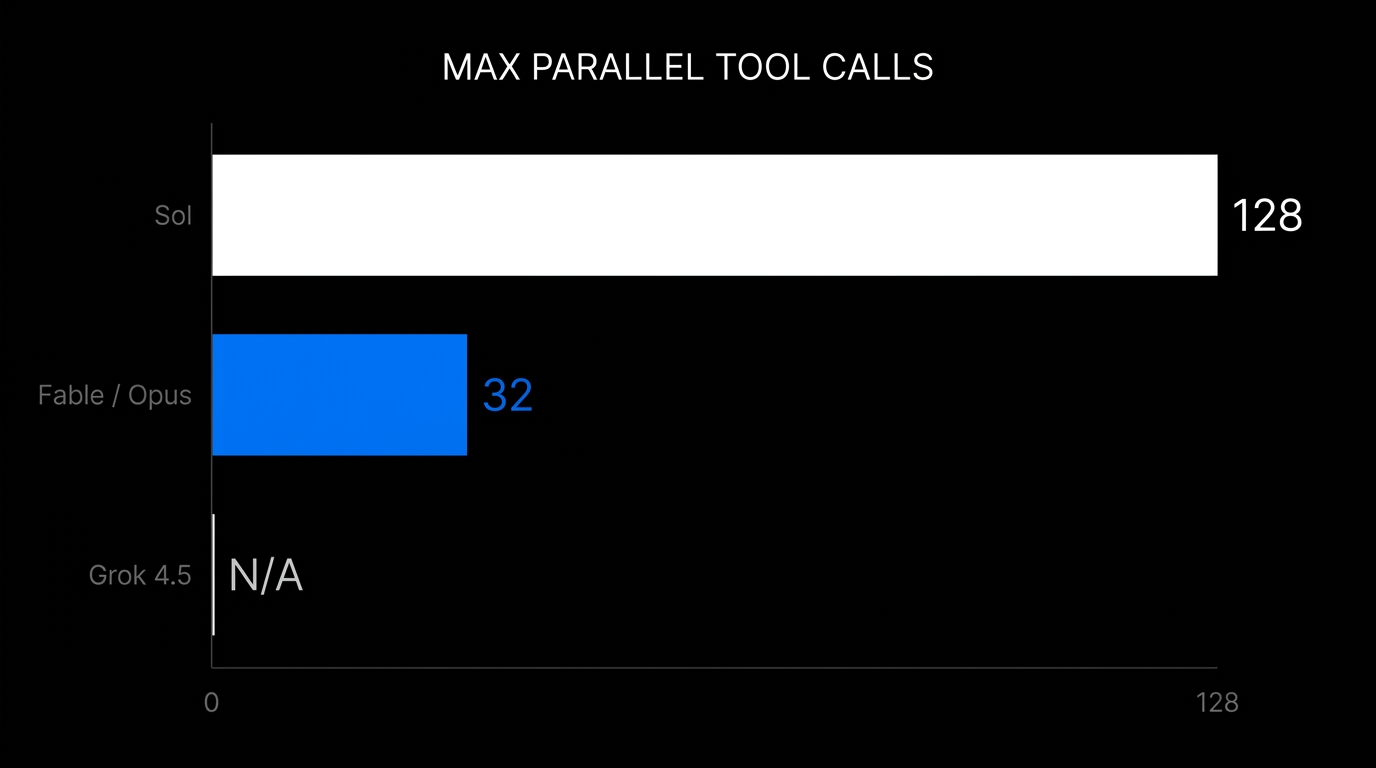
OpenAI's GPT-5.6 family (comprising Luna, Terra, and Sol) launched on July 9, 2026, with Sol serving as the heavy-duty flagship model. Sol is built specifically for native orchestration, supporting up to 128 parallel tool calls in a single turn. It dominates terminal execution, command validation, and environment configuration, scoring a massive 91.9% on Terminal-Bench 2.1. The trade-off is a heavy performance tax: Sol experiences extreme Time-to-First-Token (TTFT) latency spikes when handling complex reasoning.
Grok 4.5
SpaceXAI released Grok 4.5 on July 8, 2026. Architected as a Mixture-of-Experts (MoE) model, it is heavily optimized for IDE integrations (specifically Cursor). Grok 4.5's core strength is token overhead minimization in long-running agent loops. It is constrained by a 500,000-token context window and forces a mandatory 14-second thinking period on complex tasks, but compensates with blistering raw throughput once execution begins.
Claude Opus 4.8
Released on May 28, 2026, Claude Opus 4.8 represents Anthropic's refined, cost-effective alternative for intermediate-tier tasks. It features adaptive effort controls, enabling developers to scale model reasoning parameters down for straightforward refactoring or up for multi-step reasoning. Generating 58–60 tokens per second (TPS), it acts as a highly reliable intermediary tool.
Production Metrics: Performance & Architecture Benchmarks
Evaluating these models for production requires looking past generalized capability claims. We must look at context window utilization, rate limits, latency, and execution success rates.
- 80.0
- Fable 5 SWE-bench Pro (%)
- 64.6
- GPT-5.6 Sol SWE-bench Pro (%)
- 91.9
- GPT-5.6 Sol Terminal-Bench (%)
- 83.3
- Grok 4.5 Terminal-Bench (%)
Context Limits & Concurrency
Context windows determine the size of the repository slice your agent can ingest at once. Fable 5 and Opus 4.8 offer a comfortable 1,000,000-token ceiling, while GPT-5.6 Sol pushes slightly further to 1,050,000 tokens. Grok 4.5 is constrained to 500,000 tokens.
Concurrency limits also separate these ecosystems: the Claude ecosystem restricts you to 32 parallel tool calls, whereas OpenAI's GPT-5.6 Sol supports 128 native parallel calls.
Rate Limits
Production agent clusters quickly saturate vendor rate limits. The current limits reflect distinct infrastructure capacities:
- OpenAI GPT-5.6 Sol (Tier 5): 40M TPM / 10,000 RPM
- SpaceXAI Grok 4.5: 10M TPM / 1,800 RPM
- Anthropic Fable 5 / Opus 4.8: 2M input TPM / 10,000 RPM
Latency and Constraints
- Grok 4.5: Clocking in at 80 to 122.6 TPS, this MoE model is the fastest for interactive inline editing, though the 14-second mandatory thinking period must be accounted for in asynchronous loops.
- GPT-5.6 Sol: Standard TTFT runs between 5 and 9.6 seconds. However, during deep reasoning or heavy tool calling, TTFT can spike up to 195 seconds.
- Claude Fable 5: Architected for self-correction, Fable 5 runs slowly. It is built for asynchronous tasks where correctness is worth a multi-minute execution delay.
The Real-World Cost of Production Agents
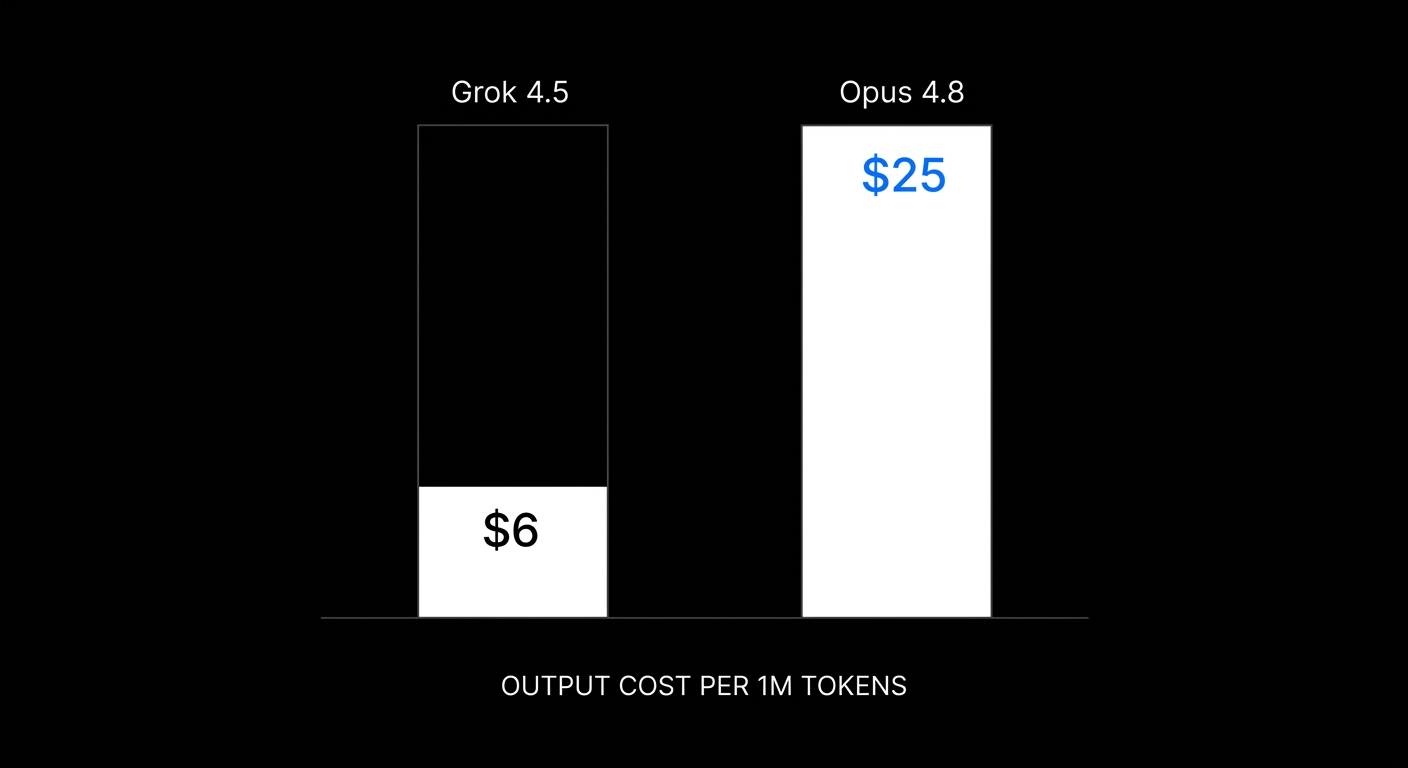
Agent loops are notoriously token-hungry. A single multi-step task can easily consume tens of millions of tokens as agents read directories, execute test suites, and refactor code.
| Model | Context Window | Input Cost (per 1M tokens) | Output Cost (per 1M tokens) |
|---|---|---|---|
| Grok 4.5 | 500,000 | $2.00 | $6.00 |
| Claude Opus 4.8 | 1,000,000 | $5.00 | $25.00 |
| GPT-5.6 Sol | 1,050,000 | $5.00 | $30.00 |
| Claude Fable 5 | 1,000,000 | $10.00 | $50.00 |
Prompt Caching and Token Overhead
To make production deployments viable, prompt caching is non-negotiable. Both Anthropic and OpenAI offer up to 90% read discounts for cached tokens. However, the write premiums differ:
- OpenAI: Offers a flat 1.25x write premium ($6.25/1M tokens) to cache the prompt.
- Anthropic: Imposes a higher write premium ranging from $6.25 to $20.00/1M tokens depending on traffic and model selection.
Optimization & Context Recall Degradation
While Grok 4.5 has a smaller context window (500k), its token efficiency is highly optimized. In long-running repository maintenance loops, Grok 4.5 often requires 4x fewer tokens than its competitors to perform the same task because of its specialized MoE architecture.
Conversely, relying on massive context windows introduces performance penalties. For example, when GPT-5.6 Sol exceeds 512,000 context tokens, its recall drops significantly to 73.8%. If your agent relies on Sol to pull a needle out of a 1M-token codebase, it is highly likely to miss crucial context.
Handling Production Hurdles & Implementation Strategy
Managing Safety Refusals in Claude Fable 5
While Fable 5 leads SWE-bench Pro at 80.0%, its strict cybersecurity guardrails represent a significant production risk. When executing complex, multi-agent refactoring tasks, Fable 5 frequently triggers safety-based refusals, returning stop_reason: "refusal".
To prevent these false positives from stalling your agent chains, you must build explicit catch-and-retry handlers into your API client.
def execute_fable_task(client, messages, system_prompt):
    try:
        response = client.messages.create(
            model="claude-fable-5",
            max_tokens=4000,
            system=system_prompt,
            messages=messages
        )

        # Intercept safety refusals before they break execution loops
        if response.stop_reason == "refusal":
            logger.warning("Fable 5 triggered safety-based refusal. Routing to fallback.")
            return fallback_route(messages)

        return response.content
    except Exception as e:
        logger.error(f"API Error during execution: {str(e)}")
        raise e
def execute_fable_task(client, messages, system_prompt):
try:
response = client.messages.create(
model="claude-fable-5",
max_tokens=4000,
system=system_prompt,
messages=messages
)
# Intercept safety refusals before they break execution loops
if response.stop_reason == "refusal":
logger.warning("Fable 5 triggered safety-based refusal. Routing to fallback.")
return fallback_route(messages)
return response.content
except Exception as e:
logger.error(f"API Error during execution: {str(e)}")
raise eStrategic Workflow Selection
To maximize engineering efficiency and minimize costs, you should route tasks dynamically based on model strengths rather than relying on a single model.
- 01
Assess
Context & scope sizes
- 02
Route
Determine optimal model
- 03
Verify
Run unit tests
- Massive Codebase Refactoring: Use Claude Fable 5. Its Dynamic Workflows and class-leading correctness (80.0% SWE-bench Pro) make it unmatched for structural rewrites, provided you budget for its $50.00/1M output cost and build error handlers for its safety refusals.
- Terminal-Heavy and Script Execution Loops: Route to GPT-5.6 Sol. Its 128 parallel tool calling capability and 91.9% score on Terminal-Bench 2.1 make it the ideal option for CI/CD pipeline automation, environment orchestration, and multi-step CLI operations.
- Inline IDE Coding and Fast Iteration: Use Grok 4.5. It is highly optimized for tools like Cursor, offering extremely low token overhead (4x reduction in maintenance tasks) and high raw throughput (up to 122.6 TPS), bypassing the high costs of Opus and Fable.
- Intermediate Coding Tasks: Route to Claude Opus 4.8. Its adaptive effort controls and solid baseline capabilities (59.0% on DeepSWE v1.1 and 69.2% on SWE-bench Pro) offer the ideal balance of accuracy and speed without the premium pricing of Fable 5.
Summary & Next Steps
The era of a single, all-purpose coding assistant is over. The current frontier requires multi-model orchestrations that align each agent's task with the correct underlying model.
If you are building code generation pipelines today, begin by separating your terminal orchestration from your deep refactoring pipelines. Route your complex repository analyses to Claude Fable 5, assign your shell executions to GPT-5.6 Sol, and keep your fast, inline edits assigned to Grok 4.5.
Join 2,0002,000 readers and get infrequent updates on new projects.


